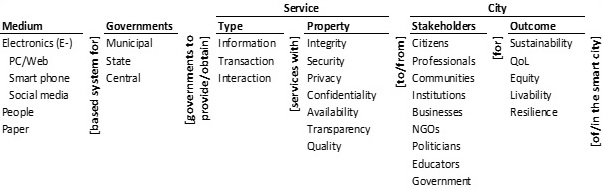
Urbanization accompanies economic development. Such a phenomenon demands cities to be smart and effective. As the country moves from being primarily agrarian economies to an industrial and a service sector economy, urbanisation is inevitable. This is because urban areas provide the agglomerations that the industrial and service sectors need. To this end, it is imperative that the ‘smartness’ of the cities is essential for the overall efficiency of the government and its services and the well-being of the citizens. The challenge of smart city initiatives is to implement tools for enabling efficiency of the government and its governance and more importantly making it participatory and sustainable. Harnessing the practice of eGovernance i.e., use of electronics (PC/Web, Smart phone and Social media) will improve efficiency of governance services to the stakeholders. However, eGovernance cannot be a stand-along instrument, the role of people (citizens and government) and paper-based functionalities is equally important.
There is a need to introduce a Project Management System (PMS), to set processes and practices to execute multiple services coordinated and monitored on a single platform. The accumulation of myriad challenges and opportunities onto a single platform, readily accessible on-site and off-site via cloud computing technologies can enable an effective and efficient smart city administration and outcomes to all the stakeholders. Figure 1, below, provides an illustration of the Governance framework for the smart city planning and management, addressing the need of a comprehensive framework for an effectual project management system. The framework, will map the blind and bright spots of the state-of-practice regarding the Tumakuru Smart City Limited (TSCL) and its vision. The framework when mapped, will provide insights on the road map for the TSCL to institutionalise improved administrative processes that will assist in plummeting the overall transaction time and cost involved in the traditional (non-smart city) practices and processes.